Continuous Customer Relationships for Competitive Advantage
Continuous Customer Relationships for Competitive Advantage
Christian Terwiesch and Nicolaj Siggelkow
Wharton Professors
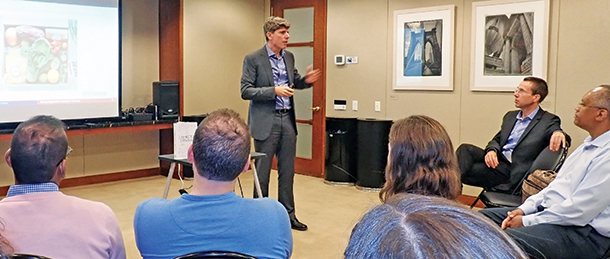
The advantages we receive here at WCNY! Wharton professor of operations Christian Terwiesch and Wharton professor of strategy Nicolaj Siggelkow offered a seminar exclusively for WCNY members on May 21. They spoke about their insightful new book, Connected Strategy: Building Continuous Customer Relationships for Competitive Advantage. A great read, it was featured as the cover story for a business school’s magazine up in Boston.
The authors posit that companies utilize available technologies to provide low-friction, customized interactions with consumers, at low cost. There are two elements. First is the connected customer relationship. Rather than waiting for the customer to come with a particular need, which the firm may or may not be able to fill — an episodic, buy-what-we-have relationship — it should seek to anticipate customers’ needs, thus providing a more curated, continuous relationship.
Second is the connected delivery model, which informs the creation of these continuous customer relationships at a very low cost. Technology makes it possible, all companies have access to the same sensors, wireless, AI and analytics.
Thus, companies must learn more about a particular customer, and customers like him or her, to earn their trust, coach their behavior and serve them on a higher level of their hierarchy of needs.
Customers have many experiences. Every time the customer loops through an experience, the company becomes better at recognizing the customer’s needs. It can become a trusted partner and climb the hierarchy of the customer’s needs.
Nicolaj explained, “In a healthcare example, let’s say I feel some heart palpitations. Then, I’d like to see a cardiologist as quickly as possible. But what I truly want is to solve my cardiac problems. Ultimately, I want to be kept healthy.
“If the provider can scale this hierarchy, I’m more willing to pay more for the higher needs. From the operations side, there are only so many things in the solution space that a provider can do to help a patient see a cardiologist. It can provide an app, and it can hire more cardiologists. Further up the scale, the solution space broadens. A provider may achieve higher goals at lower costs, and prevent the patient from needing to see a cardiologist in the first place. As it becomes a trusted partner, it doesn’t need to compete transaction by transaction.”
Christian gave a personal example. He had rented a Tesla from a private individual and driven the car around for two days, ignoring a low tire pressure signal, assuming it was because of a cold snap. While his family was at church, Tesla automatically arranged for a tow truck to bring the car in to change the tires and returned it. Tesla had tracked the car sensors and took action — staying one step ahead. Christian concluded, “At business school, we taught you to have a delivery force to fulfill the customer requests that come in — but this is about anticipating or recognizing the customers’ needs before they know it!”
Another example is Disney. On its cruise ships, it used to take a roll call of kids every 30 minutes. But on a ship moving across the ocean, how reassuring is that? Now, Disney uses sensors to geolocate kids, as well as to grant them entrance to playrooms, pay for food and more! And at Disney World, Jack Sparrow can jump out from behind the bushes and shout, “Happy seventh birthday, Sam!” And cameras positioned around the park can take photos of you on a ride, to deliver to your digital photo book!